If you're looking for an ERP solution to manage your business, you've probably come across Odoo. But what exactly is Odoo, and why are businesses around the world choosing it?
In this guide, we'll explain Odoo in simple terms, explore its history, key features, and help you understand whether it's the right ERP solution for your business.
What is Odoo?
Odoo is an all-in-one business management software that helps companies manage their daily operations from a single platform.
Instead of using different software for Sales, Inventory, Accounting, Manufacturing, HR, CRM, and other business functions, Odoo brings everything together into one integrated system. This means every department works with the same data, reducing manual work, improving collaboration, and helping businesses make better decisions.
Whether you're a startup, a growing business, or a large enterprise, Odoo offers the flexibility to manage your operations efficiently.
A Brief History of Odoo
Odoo was founded in 2005 by Fabien Pinckaers, a Belgian entrepreneur who wanted to make ERP software more affordable and accessible for businesses of all sizes.
The software was originally launched as TinyERP. As it evolved and added more business applications, it was renamed OpenERP in 2009. Later, in 2014, the company rebranded the platform as Odoo, a name that better reflects its complete suite of integrated business applications.
Today, Odoo is one of the world's leading open-source ERP platforms, trusted by millions of users in more than 170 countries. The company releases a new major version every year, continuously introducing new features, performance improvements, and usability enhancements.
Odoo Timeline
| Year | Milestone |
|---|---|
| 2005 | TinyERP was founded by Fabien Pinckaers |
| 2009 | TinyERP was renamed to OpenERP |
| 2014 | OpenERP became Odoo |
| 2015 – Present | New major version released every year |
| Today | Millions of users across 170+ countries |
Did You Know?
Odoo follows an annual release cycle. Every new version introduces improvements across existing modules while adding new features to help businesses work more efficiently.
Why Businesses Choose Odoo
One of the biggest reasons behind Odoo's popularity is its modular approach. Businesses can start with only the applications they need and add more modules as they grow.
Some key benefits include:
- One integrated platform for all business operations
- User-friendly interface
- Real-time dashboards and reporting
- Scalable for businesses of any size
- Cloud and On-Premise deployment options
- Highly customizable to fit unique business requirements
- Strong integration between all modules
Odoo Modules
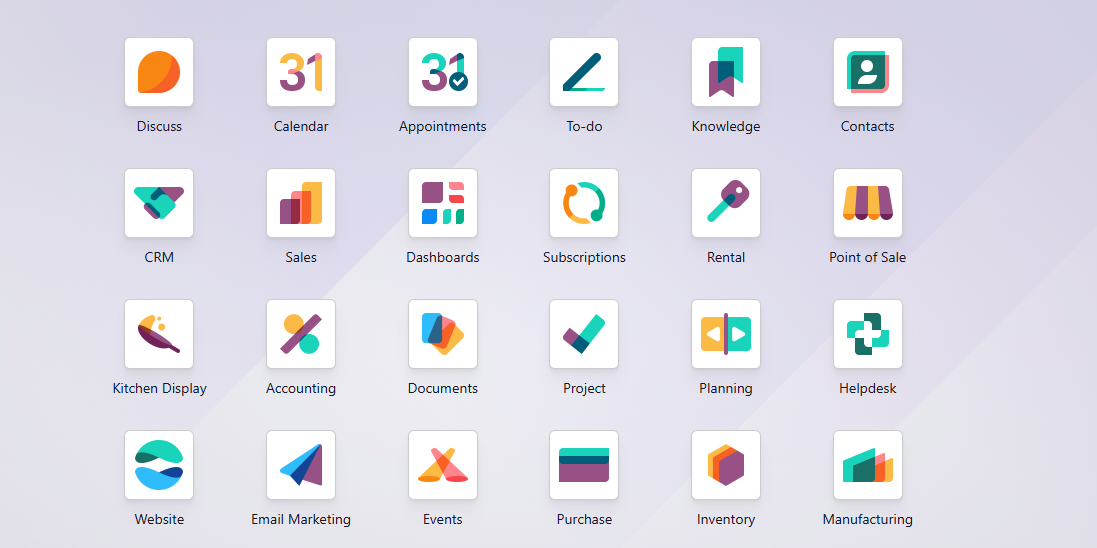
Odoo offers a wide range of business applications, including:
- CRM
- Sales
- Purchase
- Inventory
- Manufacturing (MRP)
- Accounting
- Project Management
- Human Resources
- Payroll
- Point of Sale (POS)
- Website Builder
- eCommerce
- Helpdesk
- Marketing Automation
- Field Service
- Rental
- Subscription
- Documents
- Maintenance
- Quality
The best part is that you don't need to install everything at once. You can begin with a few essential apps and expand as your business grows.
How Does Odoo Work?
Odoo connects different departments into one unified system.
For example, a typical sales process looks like this:
- A potential customer is added as a Lead in CRM.
- The lead is converted into a Quotation.
- The quotation is confirmed as a Sales Order.
- The warehouse processes the Delivery.
- Odoo automatically generates the Invoice.
- The customer makes the Payment, and Accounting records it.
Since every module is connected, information flows automatically between departments without duplicate data entry.
Who Can Use Odoo?
Odoo is designed for businesses across various industries, including:
- Manufacturing
- Wholesale & Distribution
- Retail
- eCommerce
- Healthcare
- Education
- Construction
- Professional Services
- Hospitality
- Logistics
- Non-Profit Organizations
Its flexibility makes it suitable for both small businesses and large enterprises.
Odoo Community vs Enterprise
Odoo is available in two editions:
Community Edition
- Free and open-source
- Ideal for businesses with basic ERP requirements
- Community-supported
Enterprise Edition
- Includes advanced features
- Mobile application support
- Additional business apps
- Official Odoo support
- Regular feature updates
The best choice depends on your business requirements, budget, and future growth plans.
Benefits of Using Odoo
Some of the biggest advantages of Odoo include:
- All business operations in one platform
- Reduced manual work through automation
- Better collaboration between departments
- Real-time reports and dashboards
- Improved data accuracy
- Flexible and scalable architecture
- Easy integration with third-party applications
- Support for cloud and on-premise deployment
- Customizable workflows based on business needs
Is Odoo Right for Your Business?
If your business currently relies on multiple software applications or spreadsheets to manage operations, Odoo can help simplify your processes.
It is an excellent choice for businesses looking to:
- Improve operational efficiency
- Automate repetitive tasks
- Reduce errors
- Gain better visibility into business performance
- Scale without changing ERP systems
Final Thoughts
Odoo is much more than an accounting or inventory software it's a complete ERP platform that connects every department within your organization.
Its modular design, flexibility, and continuous innovation have made it one of the fastest-growing ERP solutions in the world. Whether you're implementing ERP for the first time or replacing an existing system, Odoo provides a powerful platform to streamline operations, improve productivity, and support long-term business growth.